
Amber waves of gain.
I worked two harvests long ago, and wheat still has a pull on me.

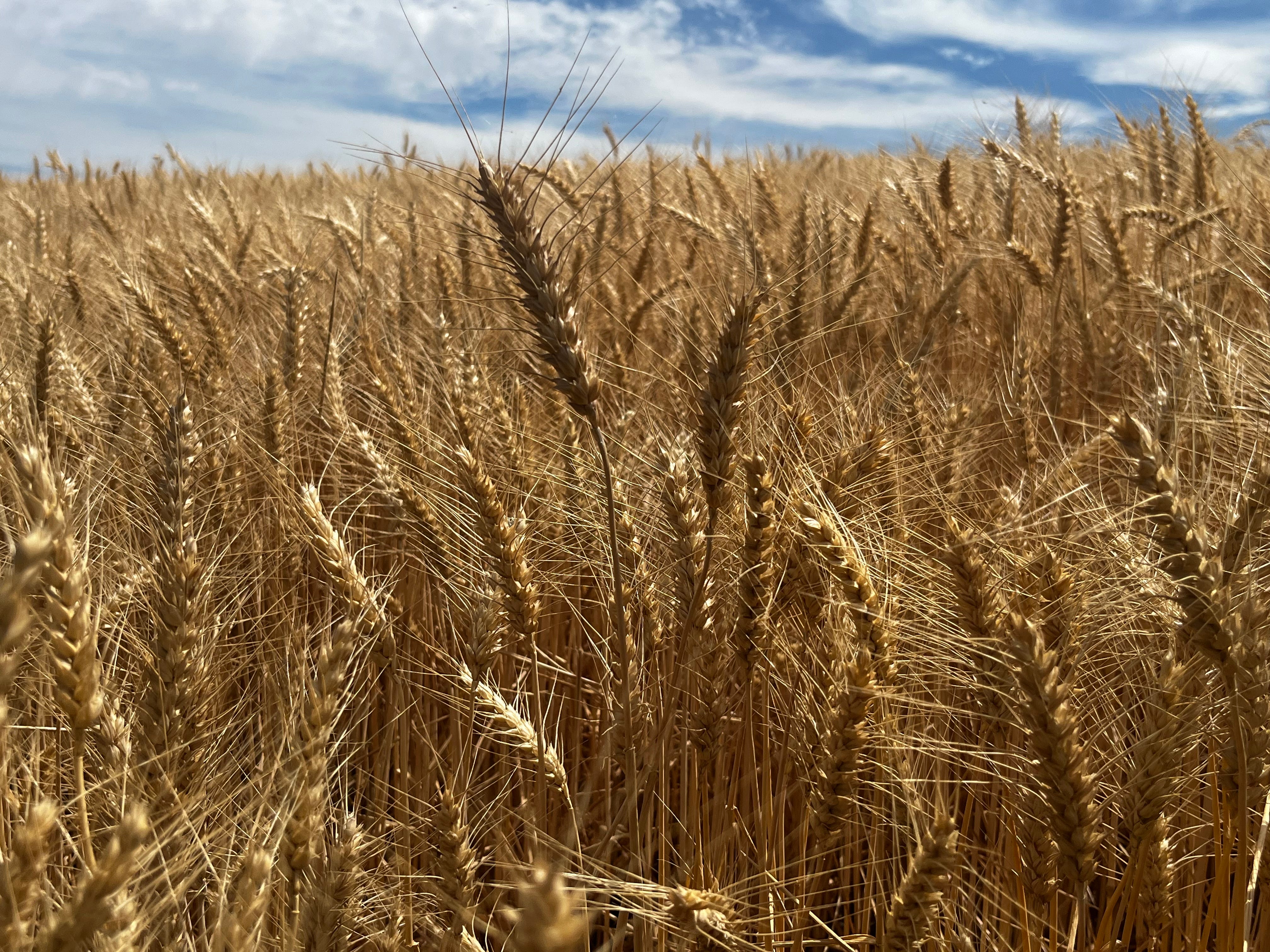
Wheat heads, nearly ready for harvest, wave in the heat outside of Condon, the Gilliam County seat in North Central Oregon. Farmers in this region primarily grow soft white wheat that is exported to Asia, where it is made into noodles, pastries, crackers and more. The Oregon wheat crop has an annual production value of about $250 million, and 90 percent of it is exported. “Feed the world,” an old harvest hand once declared to me.
I guess you wouldn’t think of Oregon as much of a wheat state — that seems more like a Midwest thing — but this time of year a big swath of the Columbia Basin east and south past The Dalles is filled with those amber waves of grain we used to sing about.
Part of the reason is a lack of water out there. Western Oregon is rainy from November to May and that’s presented as our state’s image, but broad stretches of Eastern Oregon get only 12 to 15 inches of rain per year, a third of what Portland and the Willamette Valley receive.
Luckily for farmers who need to make a living, wheat can flourish without irrigation. Planted in the fall or early winter, wheat takes hold and rides out the cold on those rolling hillsides out there. Come the dry, hot months, its roots dig down to find the rainwater and snowmelt stored during the winter. And up it comes.
I’m partial to fields of wheat, and I can’t really say why. Maybe it’s because there’s a basic strength represented there, a wholesome decency in those strong stalks and proud heads. Hearty goodness under a blue sky. Plus I do a bunch of baking and always have bags of Bob’s Red Mill flour on hand.
“Feed the world,” as that harvest hand told me. He was retired but each summer he still hired on to drive combine or truck for one of the growers out there in Gilliam County. Must have worked 50 harvests, he said.
I was lucky enough to work two wheat harvests among the many odd jobs I did before figuring out I needed to be a journalist.
The first was in 1971, the summer after my freshman year in college. The details of how I got the job are dim, but two brothers who farmed outside The Dalles needed a grain truck driver, and I ended up working for them. They lived about 30 miles from my parents’ place, where I was home for the summer, so one of the brothers, named Ken, let me stay with his family. I slept in their basement, enjoyed a hearty breakfast his wife cooked every morning, and ate an even better supper each evening.
There wasn’t much to the job, for my part. Ken drove the combine, the wheat harvester, circling the fields until the grain hopper behind his seat was full. Then he’d drive up to the truck, where I waited, and empty the hopper. When the truck bin was full, I’d drive it to the grain elevator in The Dalles, and use the truck’s hydraulic lift to raise the bed and dump the load.


I took these snapshots during the harvest. That’s Ken roaring up on the combine, the auger arm extended to unload into the trucks. The brothers had two grain trucks: A 1948 International, in the foreground, and a 1956 Ford, behind it. By the time I got back running one to the grain elevator, the second one would be loaded and ready to go.
Ken’s 12-year-old son, Alan, rode with me the first couple times because he knew the way and the routine. He was already more of a grown-up farmer than I’d ever be, but he wasn’t old enough to drive, so he tagged along.
On my first, very cautious drive to the grain elevator, the International’s steering wheel came off in my hands. I sputtered in surprise and braked to a stop, wondering what the hell. Alan calmly explained there was a cotter pin that fell out sometimes, and I just had to put it back in to secure the steering wheel.
When we got back to the field after that first trip in, I asked Alan what he thought.
“Well, you drive kind of slow,” he said.
That still makes me laugh, because it was true then and probably still is that farmers go hell-bent for leather at harvest time, when you have to beat the weather or get the crop to storage quick.
It was hot and dirty work, for sure. None of the farmers then had air-conditioned rigs or even enclosed cabs on their combines, not to mention music systems; you just rode up there in the heat and dust. That first wheat harvest, outside of The Dalles, we had a dozen straight days of temperatures over 100 degrees. That memory comes to mind anytime I want to complain about the weather.
The second wheat harvest was in 1976 when I lived in Eugene, in the Willamette Valley about 112 miles south of Portland, and home to the University of Oregon.
Needing work to pay the rent while we figured things out, my friend Russ and I hired on to work the grass seed and wheat harvests for a farmer named Rod, who leased fields in multiple spots on the outskirts of Eugene.
Rod was the most intense, demanding boss I ever worked for. He’d speed from place to place in his Chevy pickup, bouncing through the fields to check on us, cursing, issuing orders and repairing equipment on the fly. He carried a Winchester rifle in the pickup’s gun rack and a welding tank and torch in the bed. One time he nearly set fire to one of his grass fields while repairing a mower blade. Sparks from the welding work flew everywhere and I jumped from spot to spot stamping out the fires in the grass stubble as Rod bent over his work, hooded up and not seeing the near disaster he was causing. I was too intimidated to do anything but hop and stomp until he raised his hood and yelled at me about all the little fires.
Besides Russ and I, the crew included an Australian whose accent was so strong I couldn’t understand him, and Rod’s nephew, a reckless rowdy who tended to smoke cigarettes while he leaned over the opening to fill the fuel truck’s supply tank. Another guy got fired for speeding across a field and hitting a ditch, bounce-breaking the back of the heavy water truck after Rod had warned him about it. The senior hired hand, the only year-round employee, was a middle-age guy named Tom, who helped maintain all the equipment and was something of a calming influence on Rod.
I did a bit of plowing and tilling for Rod, but mainly drove an old John Deere combine to harvest first grass seed, then wheat. The John Deere had no cab, so I’d be caked with dust and sweat by day’s end. We lubed the combines every morning, especially the chattering “straw walker” mechanism that blew chaff out the back while wheat kernels piled up in the bin behind the driver’s seat.
Getting the harvest in required long days, dawn to past dusk, and at one point we worked 16 days in a row with no break. The pace was hard on Rod’s equipment, none of which he’d bought new. He was complaining about some of the other equipment breaking down when Tom noted that the old John Deere kept going.
“Well, we must have a pretty good operator on that thing,” Rod told Tom, giving me a glance and what passed for one of his smiles. I swelled with pride when he said it, because Rod was a stickler and hard to please. Later, of course, I crumpled a fender on one of his trucks when I backed into it in the dark. He was not happy.
Rod always made the first pass around the perimeter when we opened a new field; it was a tradition he’d picked up from the veteran farmer he’d worked for when he was starting out. Wanting to keep rents low, Rod instructed us to say the yield was “about the same as last year” if the landowner came snooping around.
Seeking to eke a bit more planting ground out of one leased field, Rod impulsively decided a giant stump had to go. He wrapped a chain on it and hooked the other end to the back of his biggest tractor. The tractor roared up on its back wheels with the strain, Rod sitting nearly vertical. Watching him from across the field, he looked like the Lone Ranger rising up on his rearing horse, Silver. Just when it seemed the tractor would flip over on him, Rod would push the clutch pedal in and drop the tractor back down, then back up a bit and roar away again from a slightly different angle. Nevertheless, the stump persisted.
One time my friend Russ was driving one of the tractors from one field to the next when a front wheel wobbled and incongruously spun off. Rod arrived at the scene and assessed the situation. “You’ve got to check your lug nuts,” he said grimly.
Russ and I have laughed about that and used it as a catch phrase for 50 years, because who ever — ever in their whole lives — checks their lug nuts?


Bringing in the sheaves, past and present. In these photos: My mom’s father worked the wheat fields in the Condon, Ore., area in the early 1900s, when horse teams pulled the harvesters. A more modern combine at work in the same region a few years ago. Wheat kernels and test flour at the Wheat Marketing Center research lab in Portland. A neighborhood bakery in Tokyo, where much of Oregon’s wheat crop is exported to make noodles, crackers and pastries.
I do admire all we gain from those amber waves of grain.
Thanks Eric. This a a great post of Oregon heritage. And you in the thick of it with history. Wow.
The lug nut bit cracked me up. I worked for a guy like that once. My brother and I called him “Dad,” lol.