
"He wrote beyond you."
I couldn't grasp what James Baldwin was saying the first time I read him. The second time, 50 years later, made me wobble.

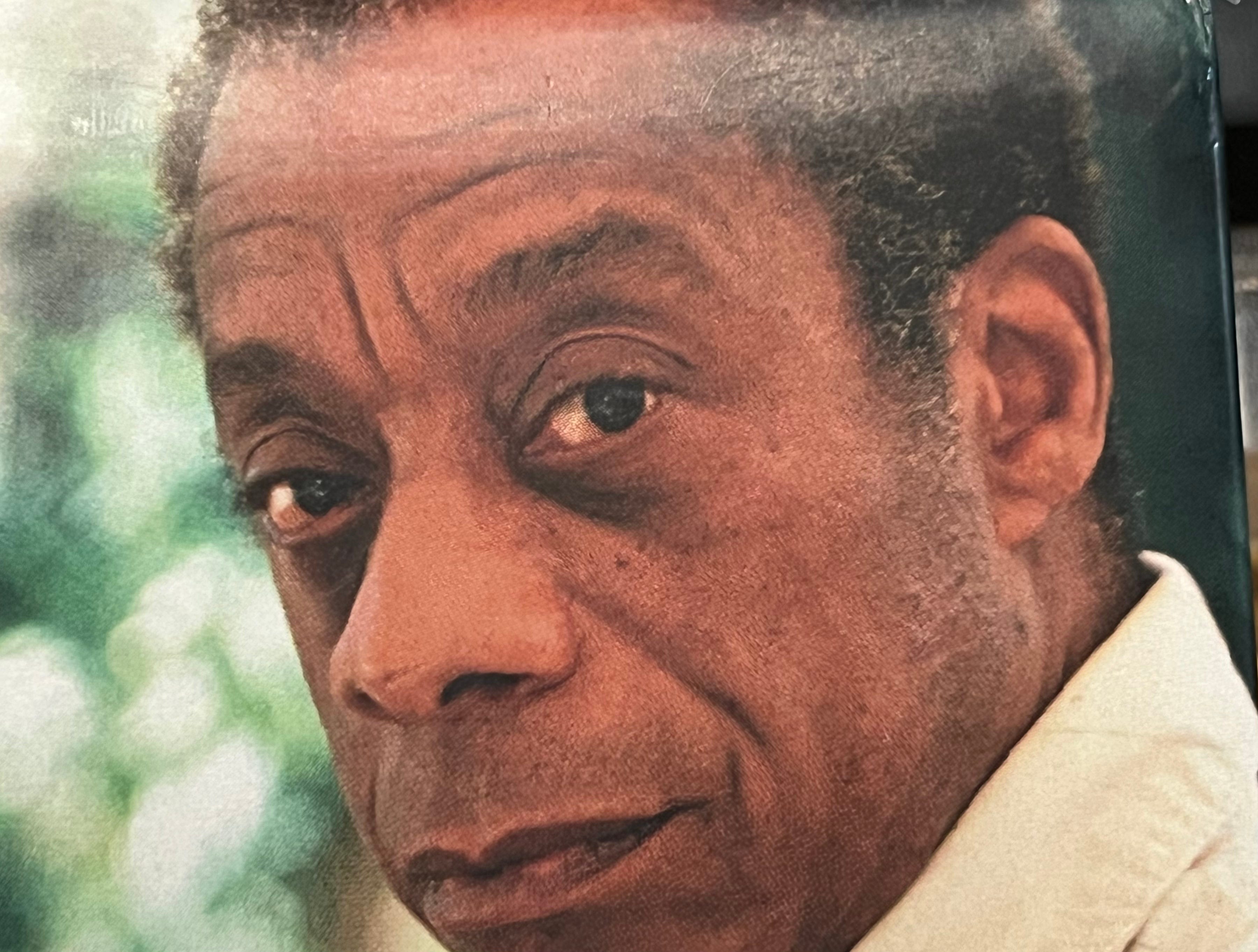
This Spring I bought a collection of James Baldwin’s essays that includes “The Fire Next Time” and “No Name in the Street.” This is a photo of the book jacket cover.
I joked to my golf friends that I had asked the late writer James Baldwin for advice on my game, and he said, "The Seven-Wood Next Time."
I like to think Baldwin wouldn’t have been insulted by my attempted sly reference to his best-known work. He wouldn’t have laughed, certainly, but I guess he would have dismissed it and kept writing.
Which is what I should do, but James Baldwin has me stymied.
“The Fire Next Time” was among the assigned reading for a college class I took in Oregon in the early 1970s. I don’t remember the class title, but I read “Fire” and came away thinking, “Man, I don’t know anything about black people.” This spring, I re-read it and the other essays in the collection, and Baldwin made my jaw drop every other page. That’s how good he was. Is.
In a book jacket blurb for the essay collection, author Ta-Nehisi Coates — a present-day marvel — said “The Fire Next Time” is “basically the finest essay I’ve ever read.”
“Baldwin refused to hold anyone’s hand,” Coates wrote. “He was both direct and beautiful all at once. He did not seem to write to convince you. He wrote beyond you.”
“Beyond you” and “direct and beautiful all at once” are perfect descriptions of Baldwin’s insight and clarity, and the pace of his writing. Re-reading his essays now, with the passage of time, it’s clear James is still beyond us, still out front, and at this point he doesn’t necessarily care if we catch up.
If we did, if we called out to him to explain what was going on, he’d say, “I told you so,” and keep walking.
My sense is that he didn’t expect much from white people, in particular, not after all this time. He knew in his bones how cruel and dangerous we’d been to black Americans throughout 400 years of our history, and we were the ones who had to set things right, not black people. We’ve had plenty of time. If Baldwin were writing today, in this trumpian age with 12-year-old bullies kicking democracy while it’s down, he’d probably just say, “Don’t act surprised.”
He was dubious about things getting better in his time. They didn’t, as it turned out. He died of stomach cancer in 1987; he was only 63.
As he said, “Life is tragic simply because the earth turns and the sun inexorably rises and sets, and one day, for each of us, the sun will go down for the last, last time.”
The last, last time.
A New York Times obituary said his “passionate, intensely personal essays in the 1950's and 60's on racial discrimination in America helped break down the nation's color barrier…” Well, I doubt he would have described the barrier as broken down, then, and of course it still isn’t.
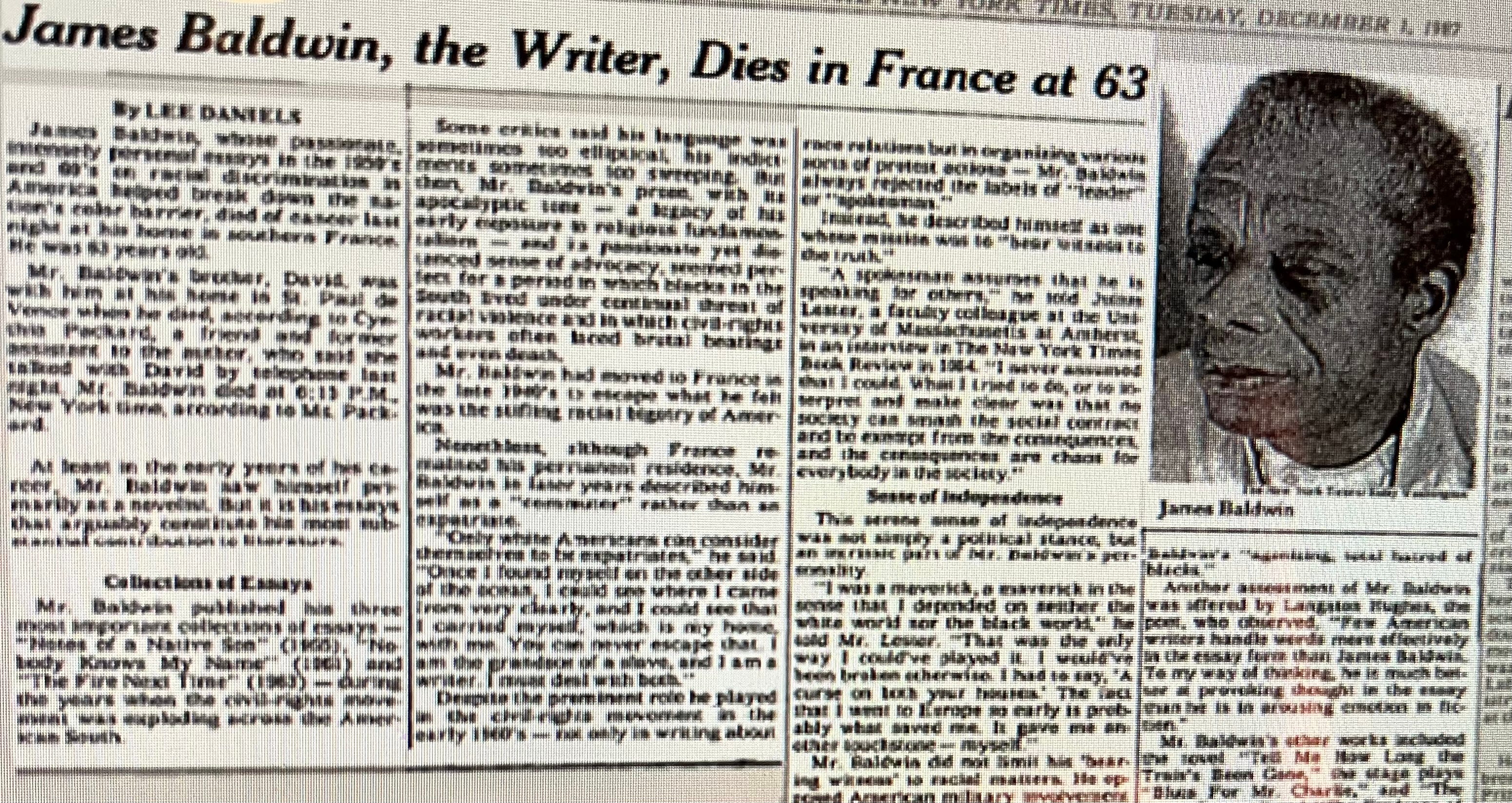
Calling him “the Writer” in the obit headline was a NY Times style standard; the newspaper still makes some reference to a person’s best known accomplishment, or profession, in its obituaries. I kind of like that tradition.
So why am I writing about James Baldwin now?
One part of that is simple: Because he was such a good writer. One of the things I tell people —one of my rules — is that if you want to be a good writer, read good writing. So that’s part of it.
Otherwise, I don’t know, except I was compelled to revisit his work. Given how things are in America, in the time of trump, I look for and listen for people telling the truth. I look for moral clarity, and James Baldwin had it.
Earlier this year I stumbled upon a couple of video interviews of Baldwin — just snippets, reels on social media — and was struck by his presence, his composure, his sharp intellect. So when I came across the essay collection at Powell’s Books in Portland, I snagged it.
Let me catch you up if you’re not familiar with him. Baldwin was born in Harlem, in New York City, in 1924, when being born black — and gay, in his case — meant you were most likely to stay poor and die early after being trapped in your place for all your short ride. His step-father was a part-time preacher of the fundamentalist brimstone orientation, and Baldwin became a bizarre teenage preacher himself before shoving religion’s hypocrisy aside to pursue Holy Literature. He’d been an voracious reader and writer from early in his school days, and writing was the train that took him beyond.
He wrote novels and plays, and earned acclaim for magazine profiles and essays that explored and explained America’s enduring racism. He knew, hung out with and wrote about civil rights leaders Dr. Martin Luther King Jr., Malcolm X, and Medgar Evers, all of whom were murdered. He understood Elijah Muhammad and the Nation of Islam movement, although he rejected its separatist racial baseline. He seemed to know everyone, including actor Marlon Brando and authors Norman Mailer and Richard Wright, who was a friend, rival and mentor. He visited film director Ingmar Bergman in Sweden for an “Esquire” magazine profile. He freely used the word “nigger,” knowing that was how America’s squirming, guilt-ridden bigotry would always see him first.
To get beyond it, as a writer and as a man, he emigrated to France when he was 24.
Eddie S. Glaude Jr., a Princeton University professor and author of "Begin Again: James Baldwin's America and its Lessons for Our Own," wrote the introduction in the essay collection I found at Powell’s.
“I wonder how James Baldwin survived here in 1948,” Glaude wrote from Paris in the introduction, in 2023.
“Young, Black, queer, and poor,” Glaude wrote. “He had never traveled outside of the United States and did not speak the language…”
“In America, he was, and could only be, a ‘nigger.’ In Paris, Baldwin fashioned himself into the writer — the poet — he imagined himself to be.”
Decades earlier, Baldwin himself had said it wasn’t an easy process. “I am the grandson of a slave, and I am a writer. I must deal with both.”
“In America, the color of my skin had stood between myself and me; in Europe, that barrier was down. Nothing is more desirable than to be released from an affliction, but nothing is more frightening than to be divested of a crutch.”
“I left America because I doubted my ability to survive the fury of the color problem…I wanted to prevent myself from becoming merely a Negro, or, even, merely a Negro writer. I wanted to find out in what way the specialness of my experience could be made to connect me with other people instead of dividing me from them.”
It’s remarkable, now, to leaf through his essays and find paragraph after paragraph that jump out ahead of you like that.
On faith:
“If the concept of God has any validity or any use, it can only be to make us larger, freer, and more loving. If God cannot do this, then it is time we got rid of him.”
On writing:
“You’re trying to tell the truth. And you’re trying to do that in a society which is committed to not hearing it. A writer is someone who has found a language to speak to other human beings. That’s all it is. It’s not deeper than that. A writer is a person who has to listen.”
On justice:
“Ask any Mexican, any Puerto Rican, any black man, any poor person — ask the wretched how they fare in the halls of justice, and then you will know, not whether or not the country is just, but whether or not it has any love for justice, or any concept of it. It is certain, in any case, that ignorance, allied with power, is the most ferocious enemy justice can have.”
Ignorance, allied with power. That’s about where we’re at today, don’t you think?
There’s another passage I wanted to share and then you can go read it yourself, which is probably the point I was trying to get to. Go read what James Baldwin had to say.
The last, last passage is about when Dr. King was assassinated in Memphis in 1968. Baldwin had appeared with MLK at some event — a fundraiser, maybe? — at Carnegie Hall, in New York City, a few short days before. Baldwin flew in from Hollywood, where he was writing a screen version of “The Autobiography of Malcolm X.”
“This was a difficult assignment, since I had known Malcolm, after all, crossed swords with him, worked with him, and held him in that great esteem which is not easily distinguishable, if it is distinguishable at all, from love.”
Baldwin had nothing suitable to wear for the Carnegie Hall appearance with Dr. King, so he hustled out and bought a dark suit and had it fitted. About two weeks later, he wore the same suit to King’s funeral.
Shortly thereafter, on another trip east from Hollywood, Baldwin encountered Leonard Lyons, a livewire columnist for the New York Post, and told Lyons he’d never be able to wear that suit again. A childhood friend of Baldwin’s learned of the resulting column and tried to contact the writer.
Baldwin reluctantly called him back; he thought the friend from his Harlem days probably wanted money.
“But, no. He, or his wife, or a relative, had read the Leonard Lyons column and knew that I had a suit I wasn’t wearing, and — as he remembered in one way and I in quite another — he was just my size.
“Now, for me, that suit was drenched in the blood of all the crimes of my country. If I had said to (the columnist), somewhat melodramatically, no doubt, that I could never wear it again, I was, just the same, being honest. I simply could not put it on, or look at it, without thinking of Martin, and Martin’s end, of what he had meant to me, and to so many. I could not put it on without a bleak, pale, cold wonder about the future. I could not, in short, live with it, it was too heavy a garment.”
But his old friend from the neighborhood needed a suit and couldn’t afford to buy one so nice, much less throw one away. He couldn’t afford what Baldwin recognized was his own “elegant despair.”
“Martin was dead, but he was living, he needed a suit, and — I was just his size. He invited me to dinner that evening, and I said that I would bring him the suit.”
Beyond.
You wrote, "Given how things are in America...I look for and listen for people telling the truth. I look for moral clarity." Well-said! Your own posts are filled with truths, sometimes uncomfortable ones, and they always make me think. it's one of many reasons I appreciate your writing. Keep bringing us those truths with your excellent storytelling!
Wonderful, compelling piece, Eric. I am going to read this Baldwin selection thanks to you. I am reminded (again) of the world widening experience my 19th and early 20th century American English class was at L&C and how far beyond me much of it was, but how bits of it have seeped back in since those 1970's days. You accelerated the seep rate. Thanks,