
About half shot
Where these stories are coming from

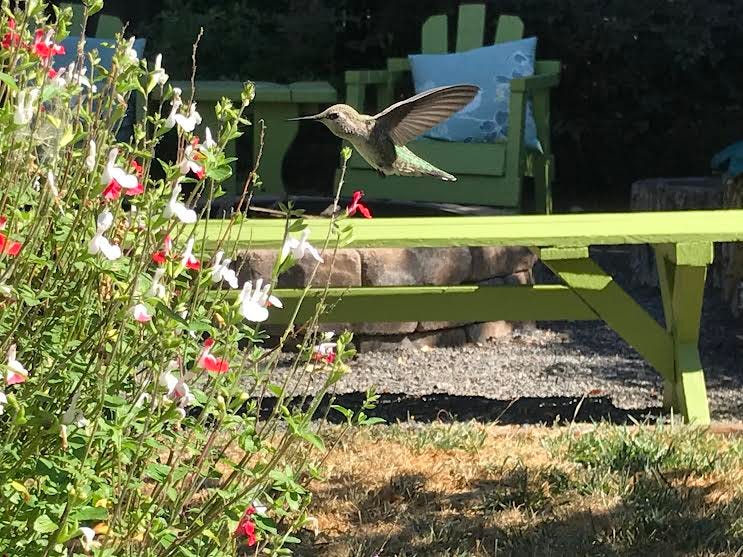
That’s a hummingbird in our backyard a couple of summers ago. They are built like Olympic swimmers, aren’t they?
The title comes from something my dad used to say. He was a short, rough and tumble guy, an ambidextrous wisecracker in coveralls. A mechanic and a body and fender man who could do about anything. Weld, wire the house, nail sheetrock left-handed and de-horn the mournful steers we raised and ate for meat. A guy of tools and two-by-fours who square danced with our mom for 50 years. A bandy-legged sailor who came home from World War II, well, came home from where the Navy based him in Canada, and produced seven baby boomers in the Columbia River Gorge, on the Oregon side.
His name was James Edward but his friends called him Jim or Jimbo. Our mom’s name was Agnes Irene, and the same hoot and holler square dance friends called her Aggie.
In our dad’s world view, anything that was worn-out or worthless was “shot” or “shot-rod.” He applied the term to vehicles, tools and to people, too, for that matter. The terms had a progression to them. Something that was on the brink of breaking down, such as a car that might not get you back home from town, was “about half shot.” Sometimes the expression took on some specificity. “The brakes on that thing are about half shot,” Dad might say.
I don’t yet know what to think about my dad. Like I told a friend once, by the time I got to the point where I knew what I wanted to ask him and what I wanted to tell him, he had Alzheimer’s. So we just laughed.
But I’ve packed that half-shot phrase with me for a lot of decades, along with many other bits and pieces, memories and moments, agates and fossils.
I’ve held on to things people said and the way they said them. I remember the way they held their mouth when they considered what life had brought them. I remember the way a woman looked at me when she wished I understood. I’ve seen that one many times, by the way.
I carry the last huffed breath of fine dogs, a couple of excellent cats, and of our dear mom, Agnes Irene. I remember how she nodded, eyes closed, when one of my sisters asked her in the last minutes whether she could see our dad, and her parents. Yes, she nodded, yes she could see them.
I also carry stories from 37 years as an Oregon newspaper reporter. Clippings and notes and quotes pulled from the storage room in memory’s basement.
I remember the way cops talked and laughed. I still see a dead teenager’s head bobbing against the steering wheel as a tow truck jerks to separate his crushed pickup from another pickup, driven by a friend of his, that he’d hit head-on playing chicken out some country road.
I hear the way two crisp soldiers climb the stairs of an apartment building to tell a dad that a roadside bomb went off and killed his son in Iraq. His son was an Army cook but was driving a supply truck because a private company had been handed the food service contract for the war over there, for some reason. I remember how the dad, red-eyed and finally worn blank, touched his son’s coffin, dark and shiny.
I still feel the anger and disgust building as a guilty woman, the coldest person I’ve ever met, sits on her parents’ couch and flippantly denies shooting her three children with a .22 pistol that was never found. One daughter died. The guilty woman slowly drove her wounded children to a hospital emergency room, where she grinned and said a shaggy-haired man flagged down her car and opened fire when she wouldn’t give him the keys. She had a wound in her left forearm to show for it.
The guilty woman answered my questions in snapped bursts. She had a .38 in the trunk, she told me in that snippy voice, “If I’d wanted to shoot my children, why wouldn’t I have done it properly?”
I think she was indignant because two of her children, a girl and a boy, didn’t die, but recovered and were adopted by the man who prosecuted their mother. The prosecutor and his wife loved those children properly.
I still see the gleam in a wheat farmer’s eye as his giant tractor slowly pulls a chisel plow through the thin soil of the Columbia Plateau. The land of winter wheat and summer fallow. There is not a building, not a vehicle and not one other person visible in that dry, empty expanse of North Central Oregon. It seems detached from the click, buzz and jump of technology and urbanity. Yet the wheat that springs from these fields, tended by plain-spoken farmers in jeans and Carhartt jackets, will go to flour mills and bakeries in Japan, Taiwan, South Korea, Vietnam and more. “Feed the world,” an old harvest hand told me.
This farmer in the tractor cab, a giant of a man who sounds just like the actor Fess Parker, takes his hands off the steering wheel and punches a button on the tractor’s console with his thick right forefinger. He grins at me.
“Now the satellite’s driving this tractor,” he says.
All those things swirl back. Dogs, kids and old ladies, my three favorite things. Old coins and older rocks, picked up and touched and reconsidered. Books I know, people I read. Baseball and football and basketball, then soccer and especially golf, and the legend of sweet swingin’ Eric Irons.
Stories from growing up the third of seven kids in Oregon’s Columbia River Gorge. Stories from Hood River and Mosier. The Stud Club, me and Oates and the legendary Rick Titus. The fun we had playing games of all kinds, like pool and Pinochle, as the Sixties burned and Casual Racism rested with its feet up in our little town. How we deployed down to Indian Creek to play Army, and how I sidestepped the danger and sorrow of a real war, sometimes to my regret.
That’s what these stories are about. I’m retired now, about half-shot myself, so it’s a good time to tell them.
This is dedicated, by the way, to my wife, Michelle Brence Mortenson. Lover and editor.
So many similar memories as a newspaper reporter/editor for small-town newspapers before many of them disappeared and I became a journalism teacher. Brings back memories. Thanks for that, I think!
This brief tale is wagging my heart!